
How to Turn Your Debate Skills Into a Standout Capstone Project
Why Debaters Make Great Capstone Researchers
If you've ever prepped for a debate round, you've already done more capstone-relevant work than you realize. Debate requires you to research both sides of an issue, structure evidence-based arguments, and defend your position under scrutiny — the exact same muscles a capstone project exercises over a much longer timeline.
Research published by Education Next found that competitive debaters read and interpret advanced non-fiction texts and social science research as part of their preparation, and that this training measurably improved literacy and critical-thinking outcomes — particularly for students who started with lower baseline test scores. That's not just a debate skill; it's a research skill, and it's exactly what a capstone project asks you to apply.
Capstone Project vs. Debate Competition: What's Actually Different?
A debate competition is a timed, structured contest where you argue a position, often against an opponent, in front of judges. A capstone project is a longer, self-directed body of work — typically a research paper, product, or presentation — that you build over weeks or months, without a scoreboard.
The overlap is in the process: both start with a research question, require you to weigh evidence from multiple sources, and end with you presenting a defensible conclusion. The difference is depth and format. A debate round might spend 8 minutes on a topic; a capstone spends months on it.
Step 1: Turn a Debate Topic Into a Research Question
The fastest way to find a capstone topic is to look at debate resolutions you've already argued — or ones that interest you — and narrow them into a specific, researchable question.
Example transformations:
| Debate Resolution | Capstone Research Question |
|---|---|
| "Governments should regulate AI more strictly" | "How have AI regulation frameworks in the EU affected startup innovation rates?" |
| "Standardized testing should be abolished" | "What is the correlation between standardized test scores and first-year college GPA at [X] university?" |
| "Social media does more harm than good" | "How does short-form video consumption correlate with self-reported attention span in teenagers?" |
Notice how each capstone question is narrower and more specific than the debate resolution — that's intentional. A debate topic argues a broad position; a capstone question investigates one measurable slice of it.
Step 2: Build a Case File Instead of a Debate Brief
Debaters build "case files" — organized folders of evidence, counterarguments, and sources for a topic. A capstone project needs something similar, just deeper:
- Primary sources: Original data, surveys, or interviews you conduct yourself
- Secondary sources: Academic papers, government data, and credible journalism
- Counter-evidence: Perspectives or data that challenge your hypothesis (a debater's instinct to "steel-man" the other side is a genuine research asset here)
- A methodology note: How you collected and evaluated your evidence, so your conclusions hold up to scrutiny
Step 3: Choose Your Capstone Format
Unlike a debate round, a capstone can take several forms depending on your topic and strengths:
- Research paper — best for policy, economics, or social science questions
- Data-driven report — best if your question involves survey or dataset analysis
- Multimedia presentation or documentary — best for topics with strong human stories
- Policy brief or proposal — best if you want to recommend a specific action, mirroring a debate's call-to-action
Step 4: Present Like You'd Close a Debate Round
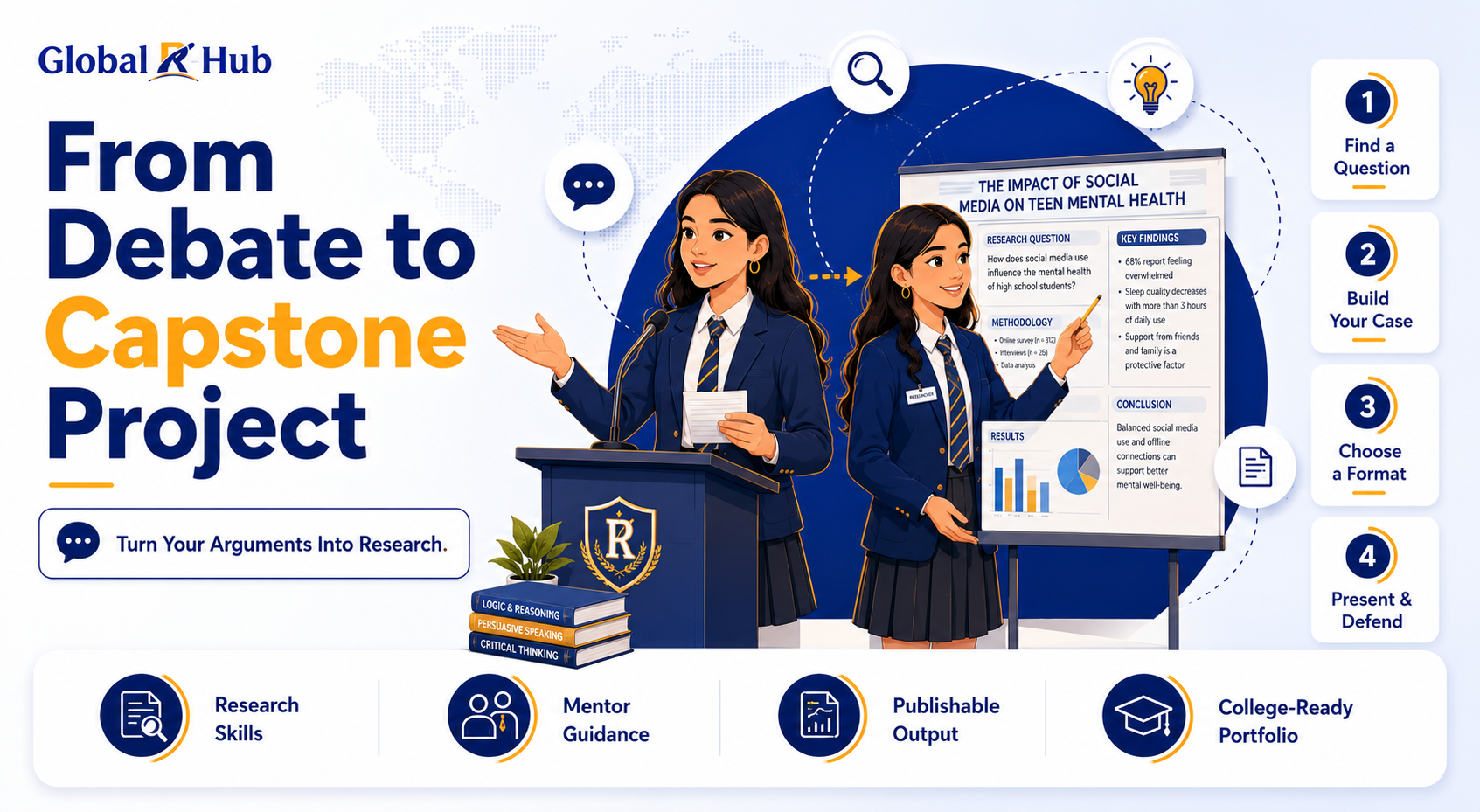
The final capstone presentation is your closing argument — except this time, you're not rebutting an opponent, you're defending your research to a panel of teachers, mentors, or judges. Use the same structure that wins debate rounds: state your claim clearly, walk through your strongest evidence, address the most likely counterargument, and close with a clear takeaway.
Where to Get Mentor Support for Your Capstone
If you want expert guidance turning a debate-honed argument into a fully researched, publishable capstone project, the High School Scholar Program pairs students with PhD mentors across fields like economics, international relations, law, and AI — many of the same subject areas that dominate debate topics.
You can also explore the full range of Global R-Hub programs, browse a bank of research project ideas if you want inspiration beyond your debate topics, or check upcoming events for research bootcamps and conferences where you can present your finished work.
FAQs
Can I use a topic I already debated as my capstone project?
Yes — in fact, it's one of the fastest ways to start, since you already understand the core arguments and likely counterpoints.
Do capstone projects require original data, like a science project would?
Not necessarily. Many strong capstones rely on analysis of existing data, literature review, or policy comparison rather than original experiments — the Lumiere Scholars Essay Award format, for example, focuses on argumentative reasoning over primary research.
How is a capstone project judged differently than a debate round?
Debate judges score you on rhetorical performance within a fixed time. Capstone evaluators (teachers, mentors, or panels) assess depth of research, originality, and the quality of your final product over a much longer process.