
The Complete Guide to the IRIS National Fair
The Complete Guide to the IRIS National Fair: India's Gateway to the World Stage of Science
If you are an Indian school student who loves asking "why" and "what if," the IRIS National Fair may be the single most important competition you have never fully understood. It is the closest thing India has to a launchpad that can take a curious 14-year-old from a school lab bench all the way to the world's largest pre-college science competition in the United States.
This guide breaks down everything you need to know: what IRIS is, why it matters, who can apply, the full timeline, the step-by-step process, the rewards on offer, and how the right mentorship can turn a rough idea into a project that actually wins.
What Is the IRIS National Fair?
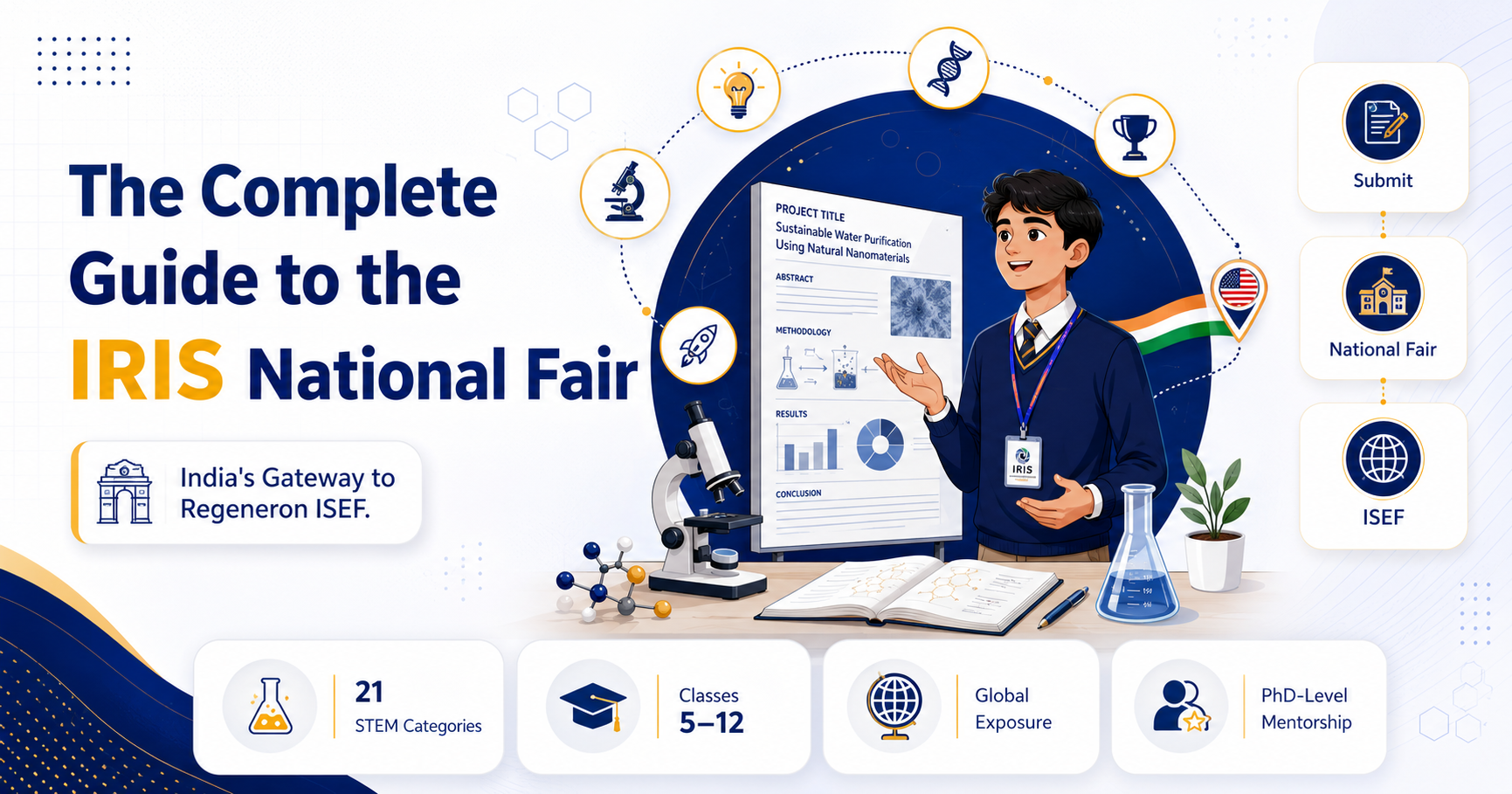
IRIS stands for Initiative for Research and Innovation in STEM. It is India's premier research-based science competition for students in Classes 5 to 12, organized by the EXSTEMPLAR Education Linkers Foundation.
Unlike a typical Olympiad, IRIS is not a written multiple-choice exam. It is a research fair. Students design and carry out an original science, technology, engineering, or mathematics project, then present their findings to a panel of expert judges,much like a real scientist defending their work at a conference.
The program has run in India continuously since 2006 (with a brief pause during the 2020-21 pandemic), and it draws young innovators from government, semi-government, and private schools across the entire country.
Its biggest claim to fame: IRIS is India's official feeder to the Regeneron International Science and Engineering Fair (ISEF) - the largest and most prestigious pre-collegiate STEM competition in the world, where students from more than 80 countries compete each year. The top IRIS winners earn the right to represent Team India at ISEF.
🔗 Official website: irisnationalfair.org
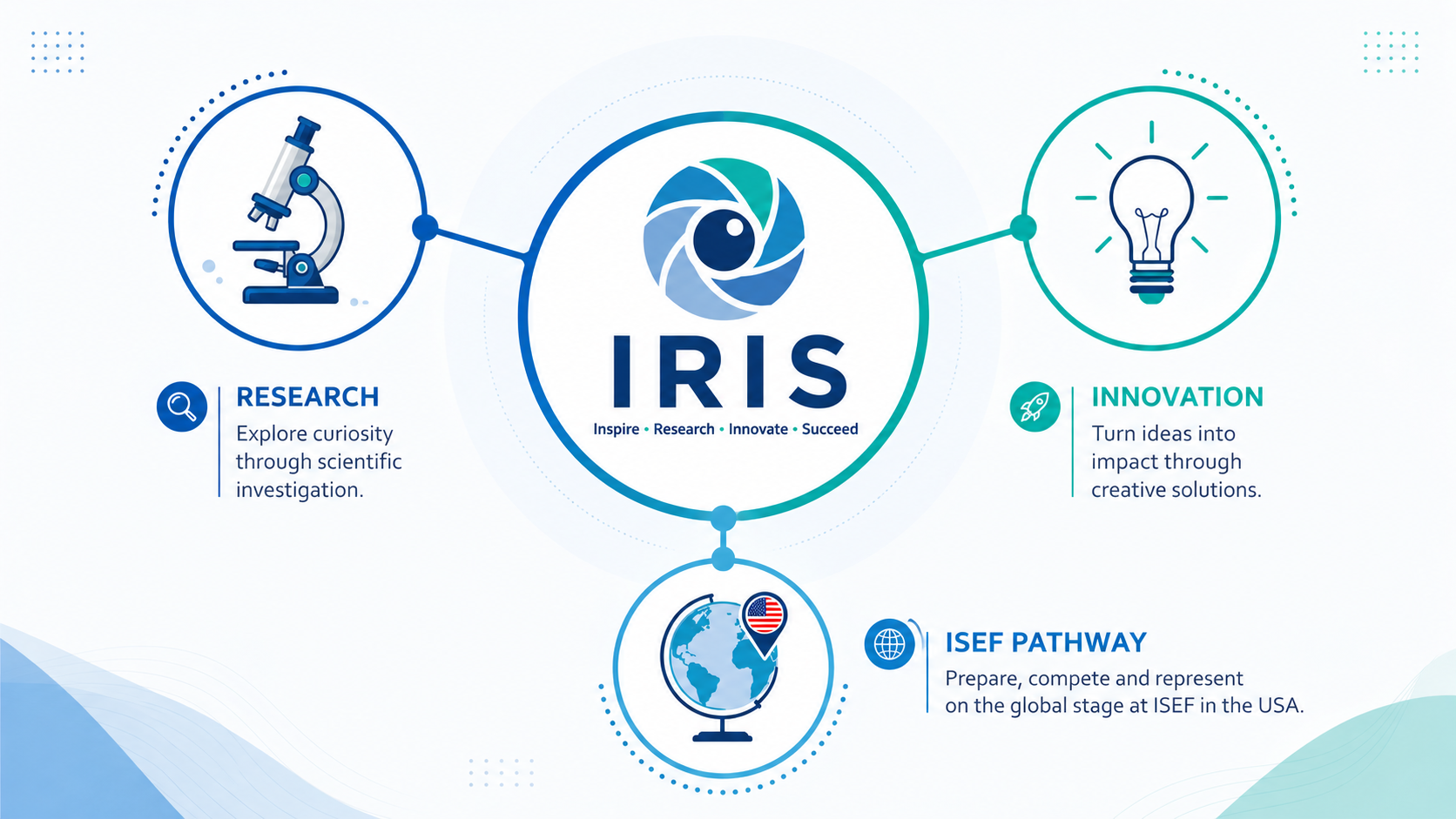
Why IRIS Is a Golden Opportunity for Indian STEM Students
Science fairs are not yet a big part of India's academic culture, and most students never get exposed to real research methodology before university. IRIS changes that. Here is why it is worth your time:
1. A genuine pathway to ISEF. Winning at IRIS can put you on a plane to the United States to compete against the brightest young scientists on the planet. Very few opportunities in India offer that kind of global exposure at the school level.
2. Real research experience, early. You learn to frame a hypothesis, run experiments, analyze data, and communicate results - skills most people don't touch until a master's degree. This is a massive head start.
3. A profile that stands out for admissions. Original research and a national-level recognition make your university application - whether for the IITs, Ashoka, or Ivy League schools abroad - far more compelling than grades alone.
4. Mentorship and a scientific network. IRIS runs mentoring camps, symposia, and workshops that connect you with scientists, researchers, and like-minded peers from across the country.
5. It rewards ideas, not resources. A prototype is not required. A novel idea, a sound hypothesis, and authentic research work are what carry a project forward - meaning a student from a modest government school can compete on merit with anyone.

Eligibility Criteria
Before you invest months in a project, make sure you qualify. The core requirements are straightforward:
- Class level: Students currently enrolled in Classes 5 through 12.
- Nationality & residence: Must be of Indian origin and residing in India.
- School type: Open to government, semi-government, and private schools - pan India.
- Team size: Projects may be submitted individually or in teams of exactly two. Teams of three or more are not accepted, and both members must independently meet all eligibility rules.
- Originality: Work must be original, authentic, and created primarily by the student(s), with clear novelty or data-backed findings. Research data cannot be more than 12 months old.
- One important restriction: A student who previously registered for IRIS as a Class 12 student cannot apply again — regardless of whether that earlier project was shortlisted. Plan your attempts accordingly.
Tip: You may submit multiple projects across one or more categories, but if two of your projects are shortlisted for the National Fair, you will be asked to choose just one to take forward.
🔗 Full official FAQ: iris.exstemplar.com/faqs
The IRIS Timeline: From Idea to ISEF
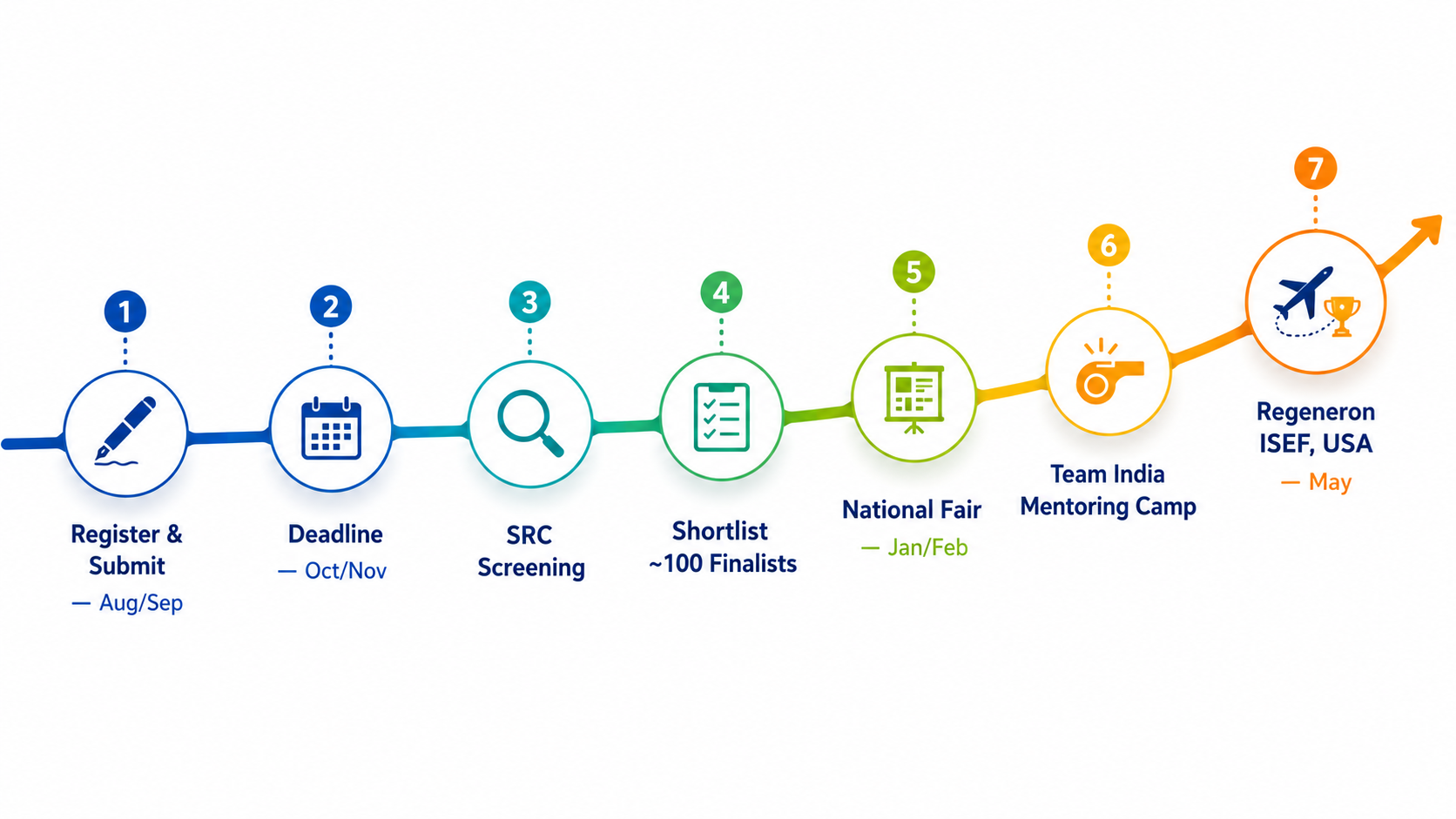
IRIS runs on an annual cycle, and understanding the flow helps you plan backwards from the deadline. Broadly, the journey looks like this:
- Registration & submission window opens - typically around August–September. IRIS usually offers submission windows around August 15 and October 15; projects submitted earlier receive earlier feedback.
- Submission deadline - around late October / mid-November (recent cycles have closed at the end of October). Late submissions are not accepted.
- Scientific Review Committee (SRC) screening - your synopsis, paper, and video are evaluated against national and international standards.
- Shortlisting for the National Fair - around 100 finalists are selected to present their work in person.
- The National Fair - held in the January–February window (the 2025-26 edition ran in cohorts across January and February 2026), where finalists present to expert judges and awards are announced.
- Team India selection & mentoring camps - top winners are groomed through intensive mentoring (posters, briefings, paperwork) for the international stage.
- Regeneron ISEF - held in the United States around May each year. (ISEF 2027 is scheduled for the Los Angeles Convention Center, May 8–14, 2027.)
⚠️ Always confirm exact dates on the official website - they shift slightly each cycle and are typically finalized in September.
How to Participate: The Step-by-Step Process
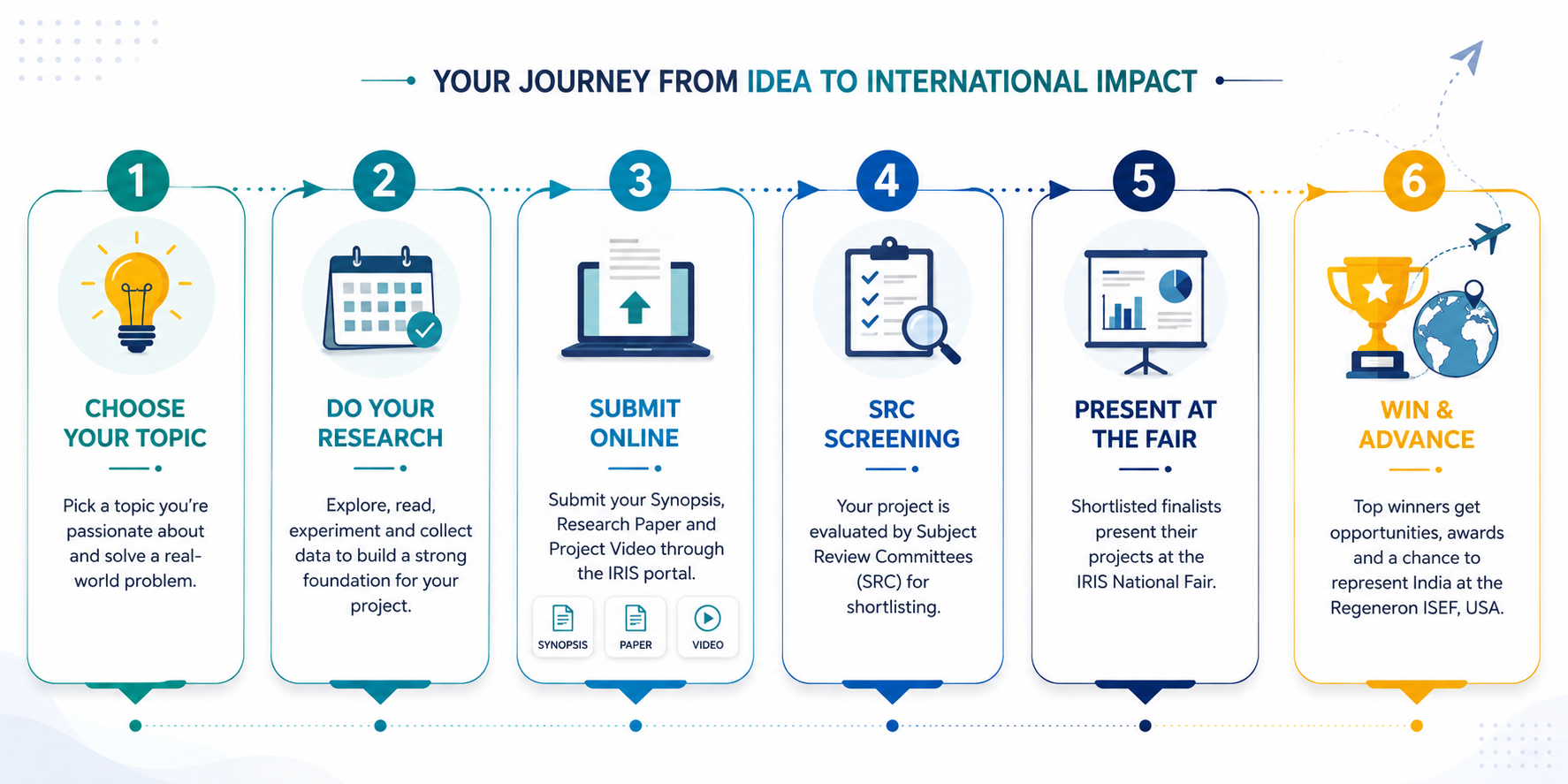
Here is exactly how a project moves from registration to a shot at ISEF.
Step 1 - Pick a category and a research question.
IRIS spans 21 disciplines, from Behavioural & Social Sciences, Biochemistry, and Biomedical Engineering to Computer Science, Environmental Engineering, Robotics, Mathematics, Physics, and Astronomy. Choose a problem that is original, testable, and connected to a real-world need.
Step 2 - Do the research.
Apply the scientific method rigorously: hypothesis, experimentation, data collection, and analysis. Support every claim with data - even a small, well-documented dataset is persuasive.
Step 3 - Register online and build your submission.
All submissions are made through the IRIS website (physical submissions are not accepted). Your entry has three required components:
- a project synopsis (structured sections: abstract ~250 words, introduction & objective, innovation, methodology, results & conclusions, references),
- a full research paper, and
- a 90-second project video explaining your work. Note: you generally must not disclose your school or city in your materials, to keep judging blind and fair.
Step 4 - Screening by the Scientific Review Committee.
Projects are reviewed for scientific merit, ethics, safety, and formatting. Only those meeting the standards advance.
Step 5 - Present at the National Fair.
Finalists set up posters and defend their work directly to judges, who probe methods, analysis, and conclusions in interactive sessions. Judging rests on four pillars: scientific merit, creativity, clarity of presentation, and real-world impact.
Step 6 - Win, and possibly go global.
Awards are announced, and the highest-ranking projects are selected for Team India at ISEF.
A quick note on fees: IRIS has historically been low-cost or free, and the current official site lists a submission fee (recently around ₹5,000 + taxes per project, with an EWS fee waiver for economically weaker students). Because this can change year to year, verify the current fee and any waiver on the official portal before you submit.
Rewards and Prestige
The tangible and intangible rewards of IRIS are significant:
- Medals and awards. Outstanding projects earn Gold and Silver medals, and there are additional honors such as Poster Awards for communication and design. National winners are recognized as Grand Award winners.
- The ISEF ticket. The ultimate prize - representing India at Regeneron ISEF, where projects can also compete for lucrative special awards from organizations like the American Psychological Association, and prizes such as a $10,000 annual sustainability award.
- Certificates and national recognition. Winning projects receive formal recognition, certificates, and media coverage - and past compendiums of winning projects have been released on National Science Day by India's Minister of Science & Technology.
- Doors that keep opening. IRIS alumni have gone on to prestigious programs like the Research Science Institute (RSI) at MIT, and the recognition supports scholarships, research publication, and admission to top universities worldwide.
More than the hardware, students consistently say the biggest reward is what the process teaches them: that science is not just about results - it's about communication, rigor, and resilience.
How Global R-Hub Can Help You Win
Here's the honest truth about IRIS: the students who reach the National Fair - and ISEF - almost always have mentors. Some work under professors; others train at dedicated STEM research centers. In a country where research methodology isn't taught in most schools, a good mentor is often the difference between a promising idea and a winning project.
That's exactly the gap Global R-Hub is built to close.
Global R-Hub is India's selective research mentorship program that pairs school students one-on-one with PhD mentors and validates their work with global university faculty. For an IRIS aspirant, that translates into concrete, stage-by-stage support:
- Finding a winning research question. Mentors help you move from a vague interest to a specific, original, testable problem - the single most important IRIS decision.
- University-level methodology, adapted for you. You learn how real researchers design experiments, collect and organize data, and run analysis (including tools like Excel, R, and JASP) - the rigor IRIS judges look for.
- A polished, submission-ready paper. Global R-Hub guides students line-by-line from first draft to a structured academic paper, and even through the publication process in peer-reviewed journals - strengthening both your IRIS entry and your university profile.
- Presentation and defense practice. Since IRIS judging weighs communication heavily, mentorship on explaining complex work simply is invaluable when you're standing at your poster board.
- Credentials that compound. Students walk away with verifiable outcomes - publications, certificates, and letters of recommendation - that make an application stand out well beyond IRIS itself.
Their track record includes 50+ students mentored, published research, and over $100,000 in scholarship funding secured - with mentors who have published in journals like Nature, Science, and Cell, and validation from faculty at institutions such as MIT, Harvard, Stanford, and Oxford.
If you're serious about IRIS, the smartest first move is to start early with expert guidance. Global R-Hub offers a free first consultation to help you map out your research plan.
🔗 Explore programs & book a free consultation: globalrhub.org
Final Thoughts
The IRIS National Fair is one of the rare arenas where an Indian school student's curiosity can be tested against the best - and rewarded on the world stage. It asks for originality, rigor, and the courage to defend your ideas out loud. None of that is easy, but none of it is out of reach either, especially with the right preparation and mentorship behind you.
Start with a question that genuinely fascinates you. Do the science honestly. Get a mentor who's done it before. And give yourself the runway to build something worth presenting.
The journey from a school notebook to the ISEF stage begins with a single submission. This might be your year to start it.
Disclaimer: IRIS dates, fees, categories, and rules are updated each cycle. Always confirm the latest details on the official website, irisnationalfair.org, before registering.